
Subscribe and receive email notifications of new blog posts.
 RSS Feed
- 2026 | 16 Posts
- 2025 | 51 Posts
- 2024 | 53 Posts
- 2023 | 52 Posts
- 2022 | 52 Posts
- 2021 | 53 Posts
- 2020 | 64 Posts
- 2019 | 56 Posts
- 2018 | 59 Posts
- 2017 | 30 Posts
14
Historic Homes in Chesterfield: Castlewood Plantation
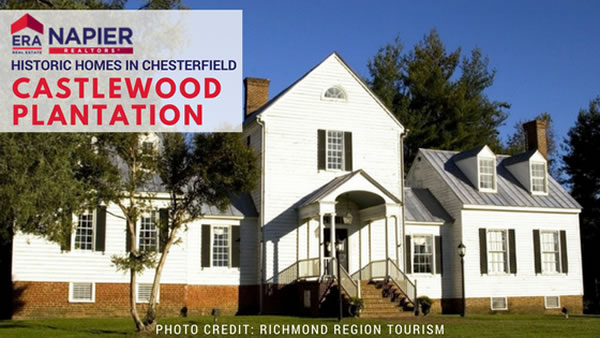
Chesterfield County homes for sale come in a wide range of architectural styles and often have strong historical influences. These classic homes are a reflection of the long history of Richmond and the important part Virginia has played in the epic of America.
Of course, not all of the most historic buildings are for sale!
One landmark that has stood the test of time is the fascinating Castlewood Plantation. Although it was renovated in the 1970s, it has remained true to its roots stretching all the way back to the early 1800s. Today, it is the home of the Chesterfield Historical Society of Virginia.
Thanks to the conservatorship of the Historical Society, visitors from near and far have a chance to see this truly unique piece of Americana up close. It has been included in the National Register of Historic Places since 1976 and has welcomed guests for decades.
The Story of Castlewood Plantation is the Story of Virginia
Although its foundation wasn't laid until 1817, the story of Castlewood Plantation begins far earlier with the 1779 birth of visionary Parke Poindexter.
Poindexter, whose family emigrated from the English Channel Isle of Jersey circa 1657, served as Chesterfield County's clerk of courts for more than 30 years, holding the position from 1812 to 1847.
He established this fine Federal period home to raise a family of six children.
Castlewood Plantation is an unusual architectural find, as it is a foremost example of the Federal period. This style was in vogue from 1785-1815 and incorporated a range of Roman and Greek influences that bring to mind the classical revival style that inspired the nation's capital.
Many homes were designed in this fashion in Parke Poindexter's day, but Castlewood Plantation stands as the top surviving example. Not only that, but it embraces emblematic elements of the style, such as the five-part layout, carved marble mantels, and formal room in the basement.
Interestingly, Federal architecture was most popular in Salem, MA – not Richmond at all.
After Poindexter's death in 1847, the property soon passed into other hands.
It was left unscathed by advancing Union forces during the Civil War, serving as a parsonage for traveling Methodist ministers during the period. Although many areas of Richmond sustained heavy damage as a result of the city's strategic importance, Castlewood was left without a scratch.
As the Civil War drew to a close in 1865, Castlewood Plantation was bought and sold many times. It was revitalized by members of the Gilmer family in 1976, including patriarch William, great-great-great-great grandson of Poindexter himself.
In 1977, Heritage Savings and Loan purchased the property and took renovation plans to a new level, hiring historians to carefully review every element and restore the property. Thus began its life as a public building – and it became a county-owned property in 1992.
Visitors Can Still See Castlewood Plantation in All Its Glory
In 1999, an anthropological dig at the Castlewood site uncovered evidence of some additional structures, which probably included a kitchen and slaves' quarters. Despite these losses, much of the building is fully intact and faithful to its original design and construction.
Today, guests to the property are welcome to explore every part of this historic dwelling. Plus, there is free public access to a historic archive including artifacts like rare books, genealogical files, scrapbook maps, pictures, and cemetery records – ideal for any local historian!
Our real estate agents are ready and waiting to help you become part of our Chesterfield County community.